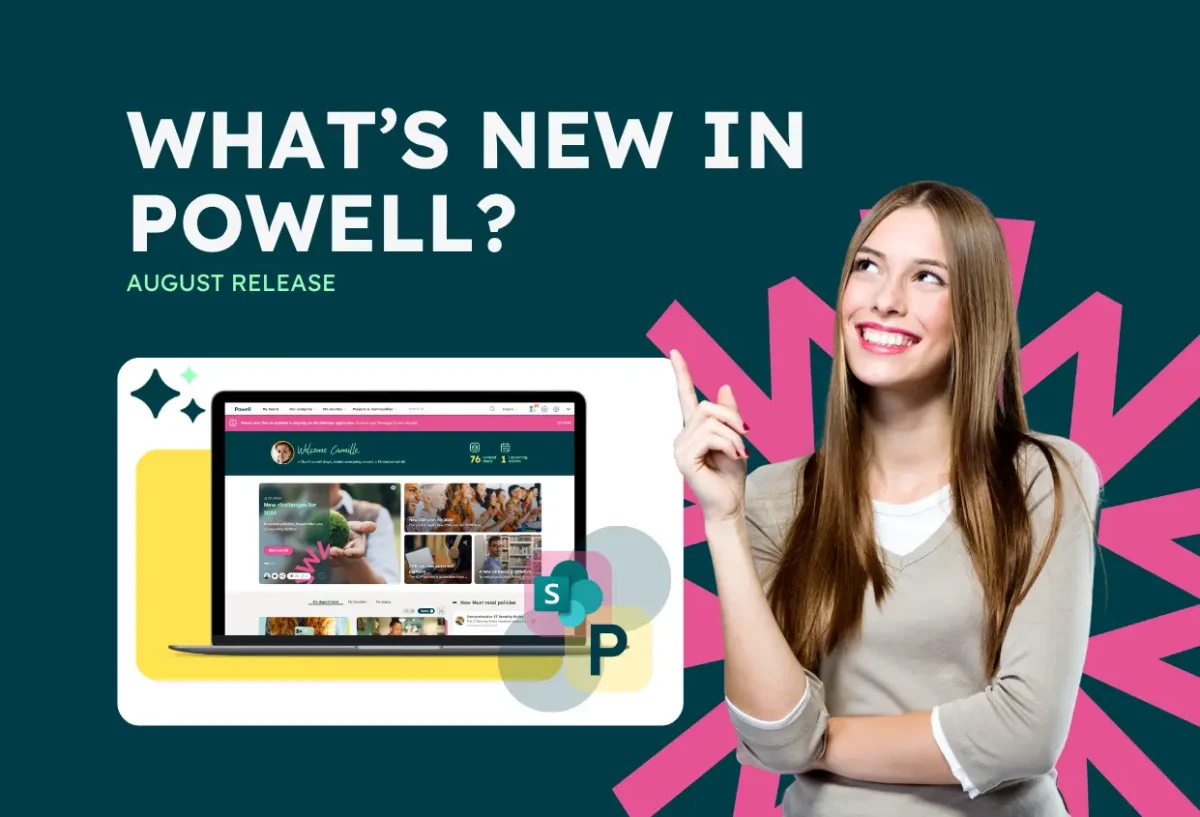
What’s new in Powell? | August 2026
From prompt to intranet in minutes
Building a digital workplace has always involved a lot of building. Powell’s new AI-powered capability, is changing that – alongside the latest developments across mobile, search, AI agents and analytics.
From a prompt to an intranet page
Creating a new SharePoint experience can be powerful. It can also require specialist knowledge, repeated configuration and several rounds of review before anyone sees a finished page.
Powell is developing a simpler starting point.
Instead of beginning with individual settings and web parts, users describe what they need in natural language:
- The purpose of the page
- The intended audience
- The tone and type of content
- The experience they want to create
From there, Powell uses AI to generate a first version of the page using the organization’s branding, Powell components, SharePoint web parts and available Microsoft 365 content.
The ambition is simple:
Go from brief to live site in minutes, NOT months.
What’s changed?
The traditional route
A lot happens before anything goes live
❌ Manual SharePoint configuration
❌ Specialist knowledge required
❌ Rebuilding similar experiences project after project
❌ Long design and review cycles
❌ Weeks before users see the result
With the new AI-powered capability
Describe what you need. Let the build begin.
✅ Generate pages from a natural-language prompt
✅ Let AI handle structure, layout and first-draft content
✅ Reuse templates
✅ Refine directly instead of rebuilding
✅ Move dramatically faster toward deployment
Describe it. Generate it. Refine it. Launch it.
The idea behind this capability isn’t to remove human expertise from intranet projects. It’s to stop wasting that expertise on repetitive configuration.
Describe
Explain the site purpose, audience and tone in natural language. Add the organization’s URL to help detect its visual identity.
Generate
This feature creates page variants using branding, templates, and Microsoft 365 content sources.
Refine
Edit with another prompt or directly on the canvas. Swap components, change the layout and adjust content in real time.
Publish
Once the page is ready, it can move through the usual SharePoint and Powell publishing experience, with the appropriate templates, features and governance applied.
Your expertise belongs in the brief – not buried in hours of configuration.
Flexible, but not a free-for-all
Anyone can describe the page they want.
But that does not mean AI is given a blank canvas to invent absolutely anything.
Powell builds from the components organizations already know and trust: Powell features, SharePoint web parts, established templates and existing governance rules.
That creates an important balance where users get the speed and accessibility of AI-assisted creation, while organizations retain the consistency that keeps an intranet recognizable, manageable and on-brand.
It is flexible enough to create different page experiences for different needs.
But it is structured enough to avoid a digital workplace filled with one-off designs, unsupported components and pages that all behave differently.
Think of it as creativity with guardrails.
The AI helps assemble the experience. Powell and SharePoint provide the trusted building blocks.
But why are we building it?
Because getting an intranet from concept to production still takes too much time.
It changes the starting point. Instead of asking teams to begin with technical configuration, it helps them begin with the outcome they want to create.
Speed to market
Move from a first brief to a tangible SharePoint experience dramatically faster – and show stakeholders something real much earlier.
Scalability
Let AI handle repetitive setup so consultants and partners can spend more time on strategy, experience and client relationships.
Consistency
Apply templates, brand choices and governance more consistently – reducing rework without turning every project into a carbon copy.
the roadmap
What happens next?
Now – Under development
The team is currently building and refining the experience of the new AI-capability.
September – Early access
The first internal and partner pilot cohort is planned to get access, with a focus on real deployment scenarios.
Q4 2026 – General availability
The planned full release includes page generation, advanced editing, the deployment pipeline and partner onboarding resources.
And that isn’t the only thing changing
While the capability rethinks how digital workplaces are created, we’re also continuing to rethink how employees experience them once they’re live…
The Powell mobile experience is getting a makeover
The intranet shouldn’t suddenly become less useful because someone closed their laptop.
Powell’s mobile experience is moving toward faster-loading, mobile-first native views with simpler authentication and more snackable content for employees on the go.
News feed
Quick access to company updates in a format designed for mobile.
Events
Make upcoming internal events easier to discover wherever employees are.
OrgChart
Find colleagues and understand teams directly from mobile.
Chatbot
Bring conversational support closer to employees from their phone.
Flexdesk
Connect workplace and desk-related experiences directly to mobile.
Frontline feed
A mobile-centric experience for employees who rarely work behind a desk.
The direction is simple
The digital workplace should travel with employees — not wait for them at their desk.
Now: design review, testing and final fixes.
August: planned early access for a first cohort of mobile workforce pilots.
September: planned global release of the new native views.
The bigger picture: Reach. Find. Act. Control.
There’s a wider shift behind these updates. AI in the digital workplace is moving beyond helping someone write a paragraph faster.
Powell’s roadmap is increasingly centered around four outcomes: helping organizations Reach employees, help them Find trusted information, let them Act without switching tools, and maintain Control as AI becomes more autonomous.
REACH
Create content faster and help it reach employees in the format that works for them.
FIND
Make workplace search smarter, more relevant and more trustworthy across company knowledge.
ACT
Move from finding answers to completing everyday workplace tasks through AI-powered agents.
CONTROL
Give IT and digital workplace teams the visibility and guardrails needed as AI expands.
Reach: create once, communicate better
These new AI capabilities are only the beginning. Powell’s roadmap also looks toward multiformat news and smarter campaign orchestration.
The ambition is to help communication teams spend less time reproducing the same message for different formats and more time improving its impact.
Find: less searching, more finding
Employees shouldn’t need to know which site, folder or system contains an answer before they can ask the question.
Powell’s roadmap includes augmented search across Microsoft 365, AI readiness improvements around M365 documents, and later, the ambition to extend search into third-party business systems.
Act: turn answers into outcomes
Finding the right policy is useful. Actually completing the task is better.
Powell’s roadmap extends AI toward Microsoft Copilot integration, frontline agents, an agents gallery and secure connections to HR and IT systems.
That means moving from:
Control: more AI needs more visibility
As AI becomes more autonomous, governance becomes more important — not less.
Powell’s longer-term direction includes AI agent governance designed to give organizations better visibility into agents and workflows: who created them, where they operate, what they interact with and what they cost.
Analytics that tell you what to do next
More data does not automatically mean more insight.
Powell is also moving toward AI-powered analytics insights across campaigns, employee engagement and search quality.
Rather than simply showing another dashboard full of numbers, the goal is to surface recommendations that help teams understand what is working, what isn’t and where they should act next.
Internal Comms
Understand which campaigns actually reach and engage employees.
Digital Workplace
Spot gaps in search quality and identify where employees are struggling.
Leadership
Move closer to measurable impact rather than relying only on activity metrics.
Final thought
A digital workplace that takes less work to make work
Put these updates together and there’s a common theme.
The digital workplace is becoming easier to create, easier to access, easier to navigate and easier to improve.
The AI-powered capability turns a brief into the beginning of a real SharePoint experience. Mobile brings that experience closer to every employee. AI helps people find information and increasingly act on it. Analytics help teams understand whether any of it is actually working.
Less configuration. Less searching. Less dashboard deciphering.
More time spent on the part that actually matters: creating a digital workplace people want to use.
Mobile
Search
Analytics

Trinity Resting
Product Marketing Manager
Product marketing doesn’t have to be all jargon and slides—Trinity’s here to prove it’s about creating human connections. With 5 years in digital marketing, she’s been scaling, building, and transforming product strategies that resonate with real people. At Powell, Trinity ensures the message isn’t just heard, but felt. She’s passionate about helping teams go beyond the office and build lasting relationships. When she’s not crafting strategies, you’ll find her sipping tea (she’s a self-proclaimed tea-aholic) or working as a professional dog sitter—because, let’s be honest, dogs are the ultimate team players.