
Every year, Gartner brings together the people shaping the future of how we work: Digital Workplace owners, analysts and leading vendors, all in one place for two days of sessions, keynotes and hallway conversations.
For Powell, being there is not optional. As a recognized intranet vendor in Gartner’s Magic Quadrant for many years, this summit is where we reconnect with peers, challenge what we think we know and calibrate what we see in the field against what analysts and practitioners are observing at scale.
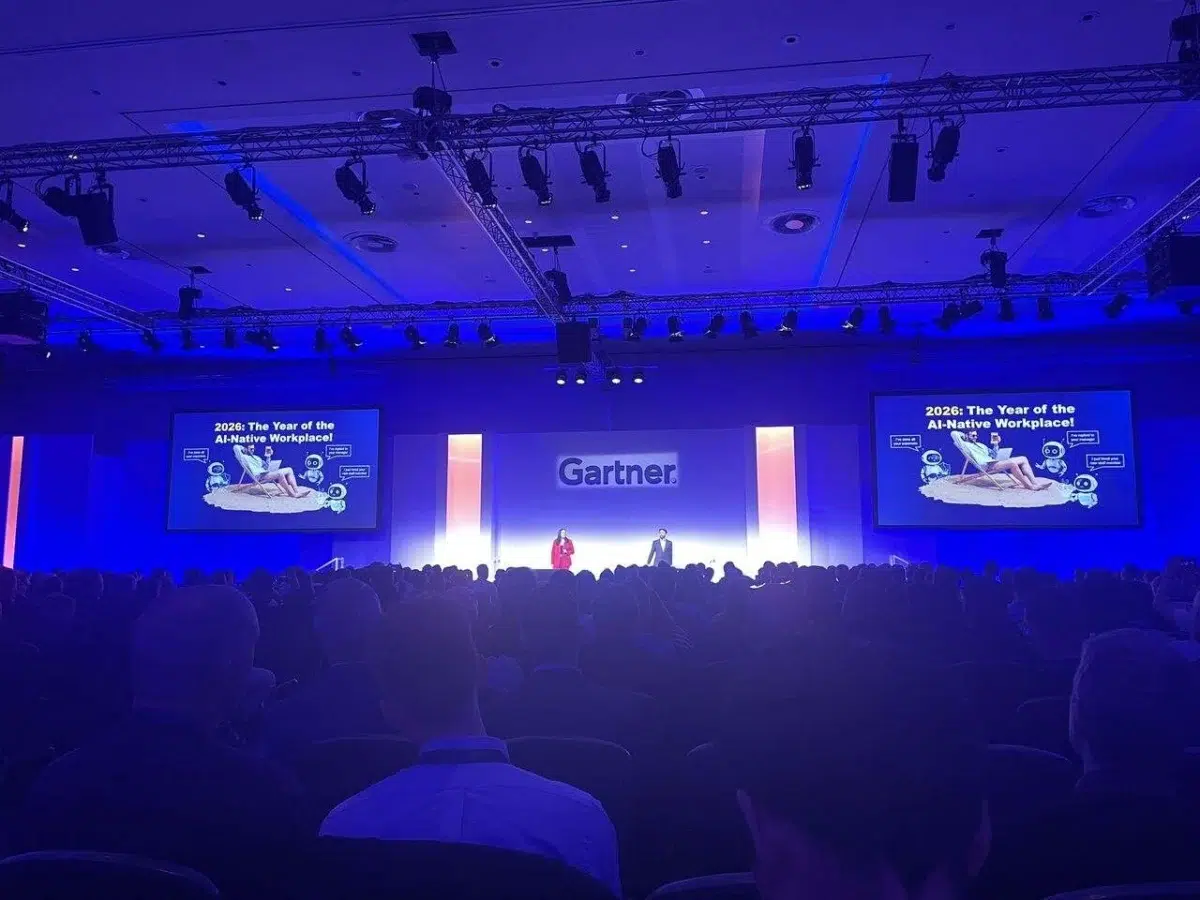
So this April, the Powell team flew to London. Two fully packed days and back-to-back sessions later, one conviction stood out: 2026 is a pivotal year for the digital workplace. Just not for the reasons you might expect.
Trust
Employees are not anti-AI. They are reluctant to rely on tools, answers or content they cannot verify.
Experience
AI adoption depends on reducing daily friction, not simply adding another shiny feature to the intranet.
Governance
AI governance is no longer just about blocking risk. It is about creating the conditions for AI to work.
01 · The human side of AI
Content trust is the real blocker. Not tech.
The uncomfortable truth running through the summit was clear: the technology is largely ready. Employees and content are not quite there yet.
Employees feel buried under hype and tools they did not ask for. AI can feel like something happening to them, not with them. That gap between expectation and experience creates disengagement.
The TRUST question
Is this content reliable?
The accuracy question
Is this response actually correct?
The decision question
Can I safely act on this output?
What actually moves the needle?
Visible leadership commitment
Not just a launch email, but ongoing signals that leadership is genuinely in this with employees.
A sense of employee control
Clear guardrails around what AI can and cannot do, plus real ways to push back and give feedback.
Space to test and learn
Deploying AI too fast can create a speed deficit that becomes a trust deficit.
02 · Measurement
Stop measuring the wrong things
One of the sharpest moments came around a deceptively simple question: how do you actually know if your AI deployment is working? Most organizations are still tracking licenses activated, Copilot seats provisioned and intranet features rolled out. Those numbers feel like progress. They are not.
Return on Employee
Your intranet and AI deployment health check from the human side.
- Reduced friction in finding documents and answers
- Daily and weekly active use rates
- Time spent interacting with intranet agents and Copilot
- Sentiment data captured at regular checkpoints
Return on Future
The longer view for the organization and how work will function in the years ahead.
- Process optimization across the digital workplace
- Reduced support ticket volume
- Faster onboarding
- Lower organizational drag from change management
The bottom line:
Your intranet is not a feature list, and your AI layer is not a chatbot bolted onto a SharePoint page. The intranet is the environment your AI operates within.
03 · AI governance
From “AI slop” to AI governance
One or two years ago, governance meant restriction: what to block, what to audit and how to stop AI from doing something catastrophic. This year, the framing shifted: how do we govern AI in a way that lets it go right?
Oversharing
Wrong people, wrong data, broken permissions.
New attack vectors
AI as a back door into the organization.
Agent sprawl
Too many agents, not enough oversight.
AI slop
Confident, wrong, duplicated or outdated outputs at scale.
AI slop is not an AI problem
It is an intranet and information governance problem that AI has made impossible to ignore. If your SharePoint is a mess of duplicated pages, outdated policies and broken permissions, AI will not clean that up. It will accelerate it.
Your AI moat starts with intranet governance
The organizations pulling ahead are not simply deploying the most agents or the most Copilot seats. They are building a reliable governance foundation.
Authoritative, updated and owned.
Easy to classify, find and reuse.
Right access, right audience, right context.
Clear ownership and verification.
04 · Success conditions
The conditions that make AI actually succeed
The organizations winning with AI inside the intranet are not necessarily the ones with the most sophisticated stacks. They are the ones that got the conditions right before they touched the tooling.
AI embedded in the intranet
If employees have to leave their digital workplace to interact with an agent, they will not.
Executive sponsorship that is felt
Not a banner on the homepage. Real, sustained commitment.
A governed intranet foundation
Layering AI onto a fragmented M365 environment amplifies the mess.
Shared ownership
Digital workplace, IT, compliance and security need to be at the same table.
The finding that hit hardest:
Miss two or more of these conditions and your AI ambitions will stall. The technology is the easy part. The conditions are the work.
Coming next…
Stay tuned for Part 2
We will go deeper on Microsoft 365 Copilot, the risks of Agent Sprawl and why Agent 365 is both promising and painfully expensive.

Trinity Resting
Product Marketing Manager
Product marketing doesn’t have to be all jargon and slides—Trinity’s here to prove it’s about creating human connections. With 5 years in digital marketing, she’s been scaling, building, and transforming product strategies that resonate with real people. At Powell, Trinity ensures the message isn’t just heard, but felt. She’s passionate about helping teams go beyond the office and build lasting relationships. When she’s not crafting strategies, you’ll find her sipping tea (she’s a self-proclaimed tea-aholic) or working as a professional dog sitter—because, let’s be honest, dogs are the ultimate team players.